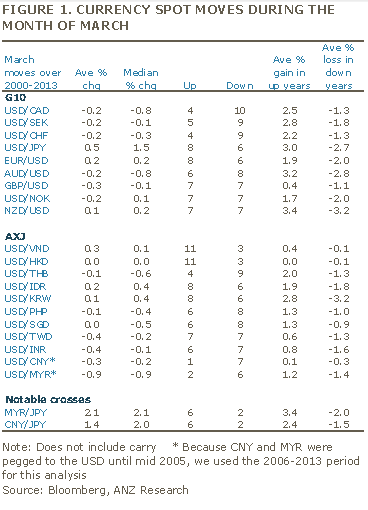
“We analysed monthly spot returns for the G10 and Asia ex-Japan (AXJ) currencies to identify seasonal patterns. Most currency seasonality analysis tends to focus only on the average percent change metric (ie spot return). This can give a misleading guide as the average could have been influenced by large moves during one or two years. Our approach is to focus on the frequency as well as the magnitude of the moves in our seasonality analysis. The idea is to identify currencies that not only have a high average percent change, but also a strong tendency to move in a particular direction during the month. Figure 1 shows how G10 and AXJ currencies have performed during March.
The common perception that the Japanese yen tends to appreciate (ie USD/JPY falls) in March due to fiscal year end repatriation flows is not supported by our seasonality analysis. Since 2000, USD/JPY has risen on eight occasions in March and fallen on six, for an average spot gain of 0.5%. What we have noticed however, is that USD/JPY has a strong tendency to start rising (ie yen depreciates) from the middle of March into early April. This occurred in 11 out of the last 14 years for an average spot gain of 1.8%.“