
EUR: Risks skewed to strength around ECB
The ECB is widely expected to cut the refi rate by 25b bps at its May meeting. Market expectations for further non-standard measures to ease credit conditions for small and medium enterprises (SMEs) are more balanced. Our economists feel the ECB is unlikely to announce this programme this week. In our view, the expectations for a rate cut should largely be priced into the EUR. Consequently, given the risk of new non-standard measures and short EUR positioning, we believe the risks around the ECB rate decision and press conference are skewed towards EUR strength. In the medium term, however, we maintain our bearish EUR/USD bias as relative growth and monetary policy support the USD in the second half of 2013.
A refi rate cut but risk-reward favours EUR strength
The key policy rate for the ECB is the refi rate which is currently at 75bps, with a corridor of 75bps. Therefore, the deposit rate is at 0% while the marginal lending rate is 1.5%. We, and market consensus, expect the ECB to cut the refi rate to 50bps while narrowing the corridor from 75bps to 50bps. This would imply that the deposit rate remains at 0% and the marginal lending rate to move to 1%.
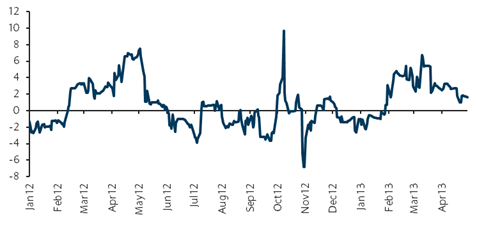
The interest rate which matters for FX is the risk free rate which, given the large amount of liquidity in the system, is currently the deposit rate for the EUR. Therefore, a cut in the refi rate is unlikely to have a large impact on the EUR in line with previous rate cuts. The effect on the EUR will largely be through the expectations channel, ie, a signal that the ECB is prepared to keep monetary policy loose. The limited impact of monetary policy on FX is also reflected in the EUR’s response to the recent weak data. The beta of m/m changes in the EUR nominal effective exchange rate to our data surprise index is close to zero (Figure 1). In other words, recent weak cyclical data has had little impact on the EUR which, in our view, is due to the ECB’s limited room for manoeuvre in loosening monetary policy further.
On the other hand, we think the risks are skewed to EUR strength for a few reasons. First, a refi rate cut should be largely priced in but the risk is that the ECB will leave the refi rate unchanged given its limited effectiveness. This is likely to be interpreted as a hawkish move and support the EUR. Second, as mentioned above, our base case is that there will be no announcement of non-standard measures to provide targeted support to peripheral SMEs. However, if the ECB does announce such a programme it will be supportive of growth expectations and consequently the EUR. Finally, widespread expectation of a rate cut has led to short market positioning raising the prospect of a short squeeze. Consequently, we think risk reward favours being long EUR/USD around the ECB rate decision and press conference tomorrow.
Medium-term EUR/USD prospects to the downside
In the medium term, however, we believe that EUR/USD is likely to move lower owing to three factors, none of which relate to monetary policy in the euro zone. The first is the effect of the BoJ measures. The knee-jerk market reaction to these measures has been EUR positive, but we would warn against chasing this further. The BoJ QE was particularly helpful for the euro area periphery, as evident from the duration rally in Italy and Spain, as well as France. Reduced market fragmentation has made it less likely the ECB will have to act aggressively. However, the impact of the BoJ’s actions on Germany remains unknown. Japanese and German export patterns are similar. Intra-industry differentiation should mitigate some of the competitive advantage of a weaker JPY but the full effect on Germany will only be clear in a few months. If damaging, the euro could take a dive.
The second factor is the new Italian coalition and its effect on EU austerity. If it manages to lead the charge against austerity in Europe, including a move towards the much-needed banking union, the EUR should rally. Better news on this front is supporting the EUR this week, despite imminent cuts and softer growth data. More fiscal transfers and less monetary easing are still the foundations of a strong euro, in our view.
Finally, a strong US economy and USD should take EUR/USD lower. We believe this factor will eventually prevail. However, we think it is too early to position for EUR weakness. Even a strong NFP number on Friday is unlikely to make markets believe in a new US growth trend after the weak March reading. One observation not does make a trend, two would catch attention, but at least three would be needed to indicate a turnaround. Therefore, USD strength is unlikely before H2.
Figure 1: Rolling beta of m/m change in the EUR to euro area data surprises is close to 0
Barclays