
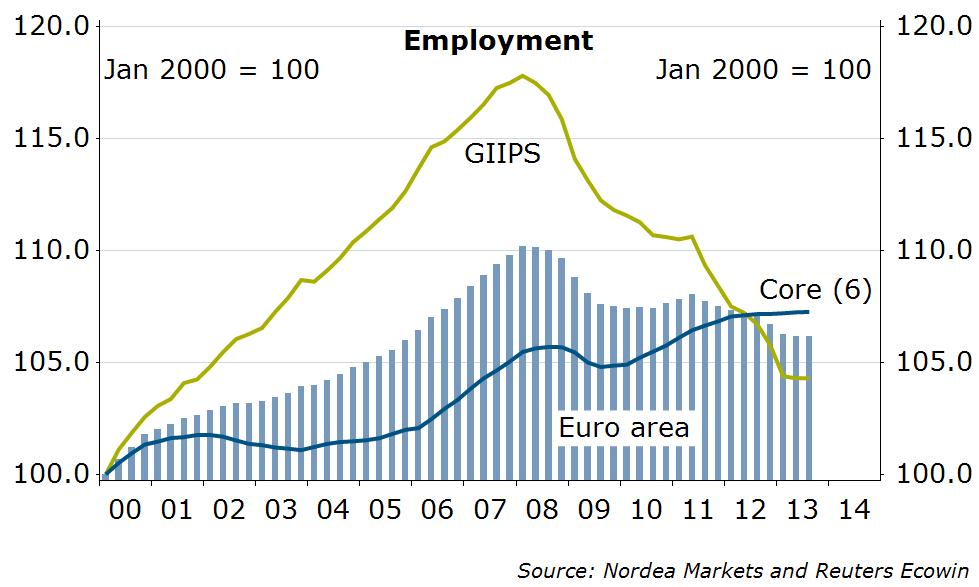
The benchmark for what can be called “positive” economic data is quite low for the Euro area. Employment no longer falling is such a positive data point, and that’s what happened in Q3, according to data released today. Moreover, Q2 was revised up to a flat reading (from -0.1% q/q). In Q3, jobs were added in various service sectors like real estate. The number of jobs declined again in manufacturing and construction. The labour market has not yet turned around in a broead basis.
On a country level, Eurostat numbers show that employment grew strongest over the quarter in Portugal and Ireland (more than 1%), confirming recent trends seen in GDP. France and Italy reported no change, while in Spain, the contraction of employment eased to -0.4% q/q which is still significant.
Fewer or no net job cuts means less job uncertainty and that should encourage European consumers to spend more. We expect private consumption to grow by 0.5% next year, contributing roughly a third to GDP growth of 1%. The slow and uneven recovery of the economy should lead to employment growing by around 0.2% next year. That would mean around 500k more jobs – which is really not a lot compared to 19.3 million people unemployed. The recovery heavily supported by the ECB still has a long way to go, especially on the labour market.
Nordea