
GDP growth confirmed at 0.3% q/q in Q3, driven by domestic demand
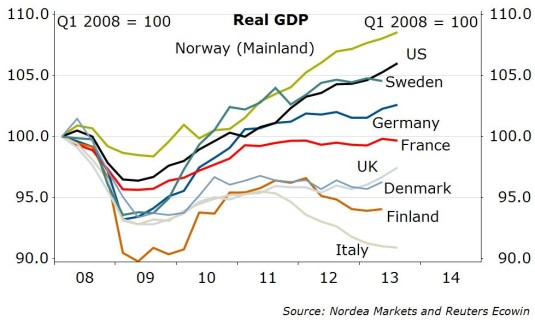
The detailed GDP data for Q3 out today confirm the view that Germany is on a stable but not on a steep growth path. Economic momentum is high enough to make most people feel good about it – and also to make many feel uncomfortable about more unconventional ECB measures like QE or negative deposit rates. At the same time, momentum is not low enough to make the (incoming) government consider forceful measures to stimulate demand and potential growth.
Germany is an export nation, isn’t it?
True, but in Q3, exports grew by just 0.1% over Q3, which means just 0.7% y/y. Net exports withdrew 0.4 %points from GDP growth in Q3. The relatively weak trend of exports reflects the economic stagnation in France – Germany’s trading partner no. 1 – and larger parts of southern Europe as well as a twofold China-effect: 1) As the Bundesbank recently noted, German car producers have shifted a significant part of their production to China so that they export less from Germany. 2) Germany produces capital goods that Emerging Markets need to develop their production capacities. The slowdown in China had a dampening effect on that. Looking ahead, German capital goods exports might not expand as much in the future than they did in the past, as China will probably succeed in basing its development more on consumption and less on investment. The subdued outlook for exports forces Germany sooner or later to rethink its own economic model. Probably later rather than sooner.
Sluggish exports to a large part explain why companies are reluctant to invest into more capacities. Spending on machinery and equipment was up just 0.5% q/q, the second increase in a row but still quite subdued – unlike construction spending which again expanded strongly. But then, due to lack of investment in the past, investment in construction is only 9% of German price-adjusted GDP. The upswing in construction is likely to go on and it bodes well for employment in Germany, but that will not save the euro periphery.
Where is the consumer?
Private consumption (56% of GDP) was surprisingly weak, expanding just 0.1% over the quarter, despite rising disposable income and stable consumer confidence. Are Germans keeping their powder dry for the Christmas season? According to some surveys, that could be the case, but we have heard that many times before.
Looking forward, we expect the German economy to grow by 1.6% next year. Around half of the increase in GDP should be driven by private consumption. We expect virtually no contribution from net exports. According to our calculations, Germany contributes almost half of the GDP growth we expect for the Euro area as a whole (1%).
Nordea