
The German Ifo business climate index declined to 106.7 in March. The decline was mostly due to lower expectations, no doubt affected by the increased uncertainty in the Euro area that has been fuelled by Cyprus and the Italian elections.

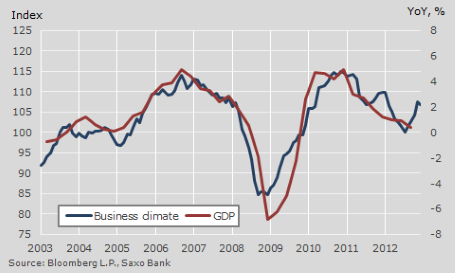
Details: The German economy continues to recovery from the steep decline in activity of 0.6 percent quarter-on-quarter in the final quarter of 2012, according to the Ifo index. However, the business climate index did slip in March to 106.7 from 107.4 in February – failing to beat expectations of 107.8 in the process. It is the first decline in five months.
The decline was mainly due to expectations, which dropped by a point to 103.6 from 104.6. The expectation component has been the key driver in the overall changes to Ifo in the downturn in the second half of 2012 and its subsequent comeback. This is because German business managers struggled to cope with a combination of uncertainty surrounding the Euro area (potential Spanish bailout request) and weaker global trade. This was confirmed in the fourth quarter 2012 GDP report, in which exports declined 2 percent quarter-on-quarter and was the main reason for the rather sharp decline in GDP of 0.6 percent.
The current assessment index has been higher than the expectations index since 2010. This was also the case in March, in which the index eased back to 109.9 from 110.2 compared with expectations of 110.5. Disregarding the fourth quarter of 2012, the current assessment index has generally provided a better reflection of the German economy (which managed a 0.2 percent gain in GDP in the third quarter of 2012 despite mounting concerns about a recession). This suggests that the expectations index has perhaps been too affected by Euro area uncertainty of late and hence overshot to the downside in the second half of 2012. The domestic strength is still there.
Looking ahead, we expect the German economy to outperform the other large economies in the Euro area with GDP growth this year a bit below 1 percent* driven not only by exports, but also domestic spending. Households are in a solid shape with unemployment close to record-low levels and real (inflation-adjusted) wage growth. This will aid GDP. Furthermore, unlike most of the Euro area, Germany has not been forced into austerity. Indeed, the government balanced its budget last year, two years ahead of schedule, due to rising tax revenues. Hence, public consumption will also grow, contributing to growth.
SAXO BANK